The 8 Best Shade Trees for Ventura and Los Angeles County
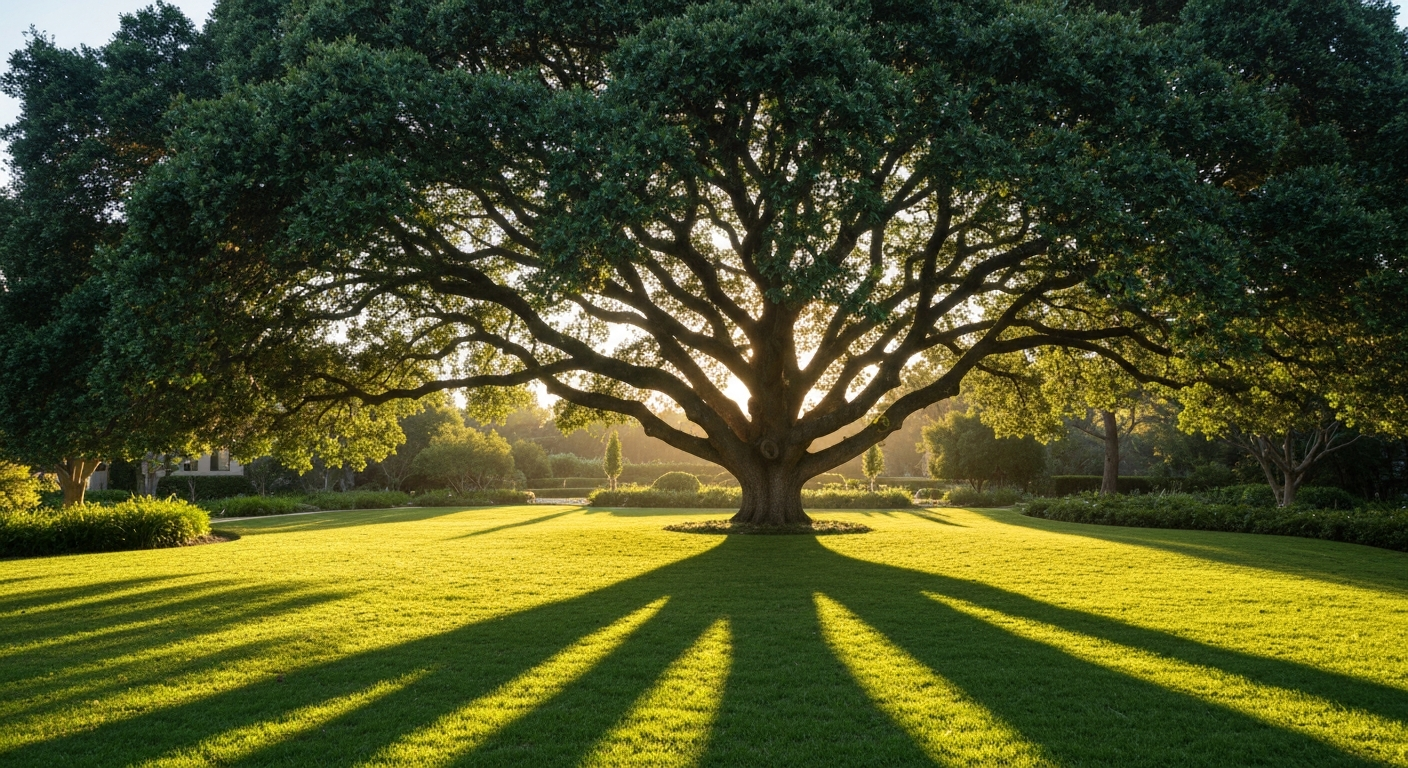
Choosing a shade tree is one of the most consequential landscape decisions you'll make. A tree planted today will define your property for decades — providing canopy, cooling your home, increasing your property value, and shaping how the entire landscape feels. Choose well, and it becomes one of the great assets of your property. Choose poorly, and you spend years managing an invasive root system, a messy drop cycle, or a species that simply struggles in our coastal climate.
I've planted and maintained trees across Ventura and Los Angeles County for over 30 years — from the avocado-lined hillsides of Ojai to the clifftop estates of Malibu to the wide lots of Hidden Hills and Calabasas. What works in the San Fernando Valley doesn't always work in the Malibu microclimate. What thrives in Camarillo may struggle in Beverly Hills.
Here are the eight shade trees I recommend most frequently, with honest notes on where each one performs best.
1. Coast Live Oak (Quercus agrifolia)
- Best for: Inland valleys, foothill properties, large estates
- Growth rate: Slow to moderate
- Mature size: 20–70 ft tall, 20–60 ft spread
California's signature tree, and arguably the finest shade tree for our region when properly sited and maintained. The coast live oak is evergreen, deeply drought-tolerant once established, and supports more native wildlife than virtually any other tree in Southern California.
Its reputation for difficulty comes from one issue: summer irrigation. Established coast live oaks should never receive summer irrigation within the drip line — it encourages Phytophthora root rot and sudden oak death. This makes them challenging in irrigated landscapes but magnificent on dry slopes and open areas.
For large properties with space to let a coast live oak grow on its own terms, there is no better choice.
2. Southern Magnolia (Magnolia grandiflora)
- Best for: Coastal and inland neighborhoods, estate lawns
- Growth rate: Moderate
- Mature size: 60–80 ft tall, 30–40 ft spread
Few trees make a more dramatic statement than a mature southern magnolia — the large, glossy leaves, the massive white blooms in summer, and the year-round density of the canopy. It's an excellent lawn tree that provides deep shade and holds up well to the coastal marine influence.
One honest note: it drops leaves, seedpods, and spent flowers year-round. This is not a low-maintenance tree from a cleanup standpoint. But on a large property where the canopy is the star, most owners find the tradeoff well worth it.
3. Brisbane Box (Lophostemon confertus)
- Best for: Streetscapes, smaller lots, coastal properties
- Growth rate: Moderate to fast
- Mature size: 30–50 ft tall, 20–35 ft spread
One of the most underused shade trees in Southern California, the Brisbane Box is a workhorse — clean, dense, pest-resistant, and adaptable to coastal conditions. It produces a tight, rounded canopy that provides good shade without the aggressive root system of many comparably sized trees.
This is my first recommendation for homeowners who want a substantial shade tree but have concerns about roots near hardscape, pools, or structures. It's also one of the best performers in our coastal fog belt.
4. Desert Willow (Chilopsis linearis)
- Best for: Hot inland valleys, drought-prone properties
- Growth rate: Fast
- Mature size: 15–30 ft tall, 10–20 ft spread
Technically a large shrub/small tree, the desert willow is spectacular in the right setting — fast-growing, drought-tolerant, and covered in trumpet-shaped flowers in shades of pink, lavender, and white from spring through fall. It provides dappled shade rather than dense canopy, making it excellent under-story for sitting areas and patios where full shade would feel oppressive.
Best suited to the hotter, drier areas of our service territory — the Simi Valley, Moorpark, Thousand Oaks, and Santa Clarita corridors.
5. Chinese Elm (Ulmus parvifolia)
- Best for: Most neighborhoods throughout the region
- Growth rate: Moderate to fast
- Mature size: 40–60 ft tall, 40–60 ft spread
One of the most reliably excellent shade trees for the entire Ventura/LA region. The Chinese elm has a graceful, arching canopy with attractive mottled bark, provides good summer shade while allowing filtered winter light, and tolerates a wide range of soil conditions. It's semi-deciduous in our climate — dropping some leaves in winter without going fully bare.
Unlike the American elm, it has strong resistance to Dutch elm disease. It does require regular structural pruning when young to develop good architecture, but once established it's low-maintenance and exceptionally long-lived.
6. Jacaranda (Jacaranda mimosifolia)
- Best for: Coastal communities, estate lawns, statement trees
- Growth rate: Moderate
- Mature size: 25–45 ft tall, 30–60 ft spread
Every May and June, Los Angeles turns purple. Jacarandas are iconic for good reason — the canopy of lavender-blue blooms is one of the great horticultural spectacles of Southern California. They provide light, dappled shade with an open canopy that suits patios and outdoor living areas particularly well.
Two caveats: the fallen flowers are abundant and create a slippery surface on hardscape, and the roots can be aggressive near pavement. Site them carefully — at least 10 feet from any hardscape — and enjoy one of the most beautiful flowering trees in the world.
7. California Sycamore (Platanus racemosa)
- Best for: Large properties, riparian areas, statement landscapes
- Growth rate: Fast
- Mature size: 50–100 ft tall, 40–70 ft spread
A magnificent native tree when given space to grow. The California sycamore produces a massive, sculptural canopy with stunning white and tan mottled bark that becomes more dramatic with age. It's fast-growing, deeply shade-producing, and a landmark tree on any large property.
It requires room — this is not a tree for a small lot or near structures. But on an estate or large ranch setting, a sycamore is incomparable. It also requires adequate water — it's naturally a riparian species — so it performs best in areas with irrigation access or in low areas that collect seasonal water.
8. Crape Myrtle (Lagerstroemia indica)
- Best for: All neighborhoods, patio trees, smaller gardens
- Growth rate: Moderate to fast
- Mature size: 15–25 ft (standard varieties), 6–15 ft (semi-dwarf)
Technically a large shrub that's trained into tree form, the crape myrtle is the most forgiving and versatile ornamental tree in our climate. It blooms heavily in summer in shades of white, pink, red, lavender, and deep purple, provides good shade for its size, and has attractive exfoliating bark that looks beautiful in winter.
One important note: do not "crape murder" your crape myrtles. The practice of cutting the main branches back to stubs — widespread and unfortunately common — permanently disfigures the tree and is completely unnecessary. Proper pruning removes only the small crossing and dead twigs at the branch tips. A well-maintained crape myrtle is a graceful, beautiful small tree. A "crape murdered" one is a sad collection of knobby stubs.
How to Choose for Your Property
The right tree depends on your specific site conditions, lot size, proximity to structures, soil type, sun exposure, and how much irrigation you're able to provide. What works beautifully on a large Malibu estate may be completely wrong for a Camarillo garden.
When we do site consultations, we walk the property with you, assess the existing conditions, and recommend species that will genuinely thrive in your specific microclimate — not just species that will survive.
If you're considering adding shade trees to your property, we'd love to help you choose well. A 30-minute consultation now can save you years of disappointment later.
Need an Expert Assessment?
Our arborists on staff can help you establish the perfect planting strategy for your property.
Request a Free Consultation