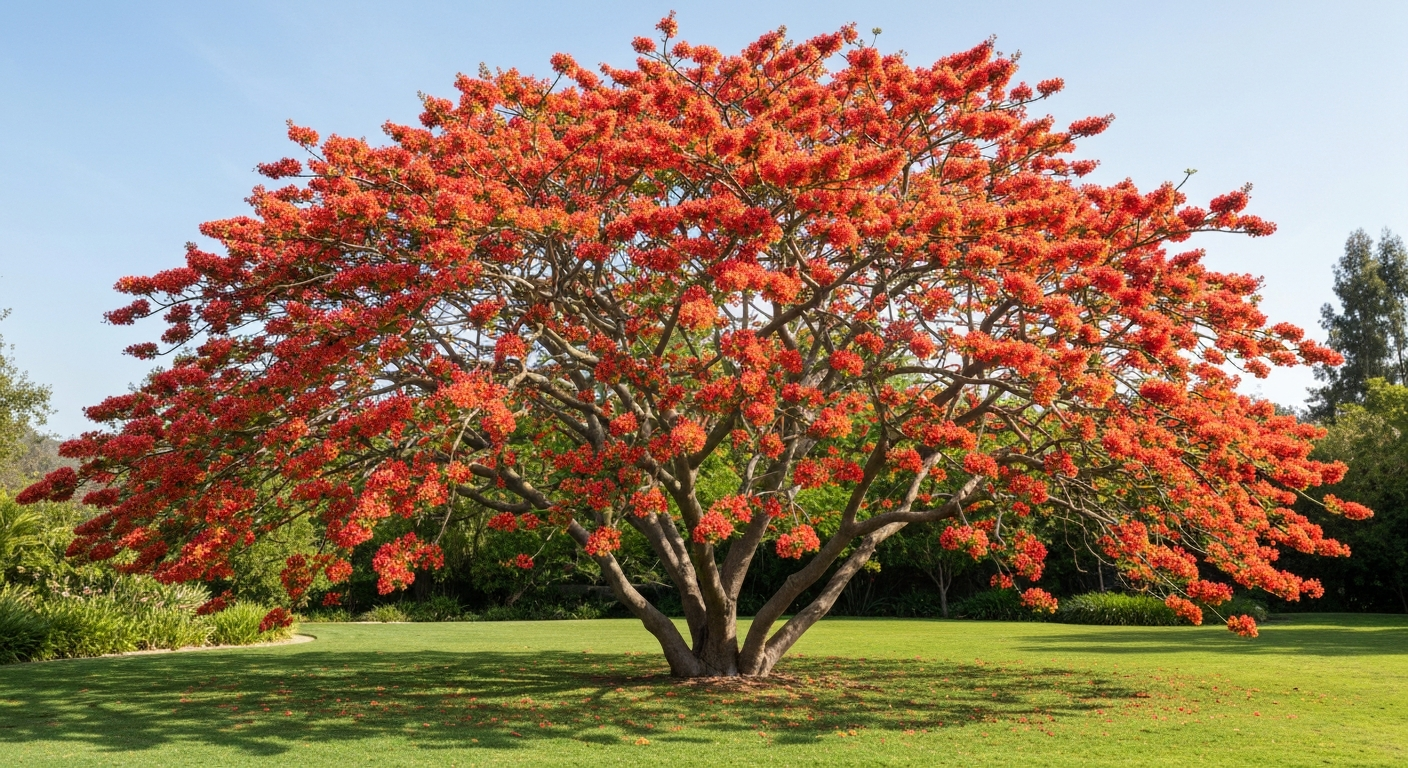
Coral Trees
Care Guide
Among the most spectacular flowering trees in Southern California — and among the most structurally vulnerable. Brilliant blooms require disciplined arboricultural management.
Understanding Coral Trees
Southern California is home to several species commonly called Coral Trees, with the Naked Coral Tree (Erythrina coralloides) and the Kaffirboom Coral Tree (Erythrina caffra) being the most common in landscapes. The City of Los Angeles has planted thousands along Wilshire Boulevard and other prominent corridors, making it one of the region's most recognizable street trees.
Coral Trees bloom spectacularly — brilliant red, orange, or coral-colored flowers appear on bare branches in winter and early spring, creating a dramatic display before the large, tropical-looking leaves emerge. For estates seeking year-round visual interest, few trees compare during their bloom cycle.
The critical issue with Coral Trees is wood strength. Their rapid growth produces lightweight, brittle wood that decays readily. Large limbs can fail suddenly without warning, even on apparently healthy trees. This is not a tree that tolerates deferred maintenance. Regular structural pruning and professional monitoring are essential, not optional.
In the right setting, with the right management, Coral Trees are extraordinary. Without it, they become a liability.
Quick Reference
Common Problems With Coral Trees
Brittle Wood & Limb Failure
The number one hazard with Coral Trees. The wood is lightweight and decays rapidly once a wound is created. Large limbs can fail with little to no external warning. Trees near driveways, parking areas, and high-foot-traffic zones require formal risk assessment. Annual inspection by an ISA Certified Arborist is strongly recommended for all large specimens.
Wood Decay & Hollow Trunks
Erythrina wood decays quickly following pruning wounds, storm damage, or insect entry points. Hollow trunks are common in older specimens. A tree can appear full and healthy above while harboring significant internal decay. Resistograph testing and sonic tomography can evaluate internal condition without invasive sampling.
Erythrina Gall Wasp
An invasive pest first detected in California in 2005, the Erythrina Gall Wasp (Quadrastichus erythrinae) has devastated Coral Tree populations in Hawaii and poses a serious threat in Southern California. It causes galls on leaves, petioles, and stems, deforming new growth and weakening trees significantly. Monitor new growth closely and report unusual leaf deformation to a Certified Arborist.
Root Zone Issues
Surface roots of mature Coral Trees can be significant and aggressive, lifting hardscape and competing with nearby plants. Cutting surface roots without proper assessment can destabilize the tree. Never cut roots near a mature specimen without a Certified Arborist evaluation.
Frost & Cold Damage
While generally cold-tolerant for a tropical species, Erythrina caffra can sustain tip and stem damage in hard frosts. Interior valley locations (Thousand Oaks, Moorpark) should consider the occasional cold night. Frost-damaged growth should be removed in spring once new growth confirms the extent of dieback.
Improper Pruning
Topping and severe heading cuts are among the most common and damaging practices applied to Coral Trees. These cuts create large wounds that invite decay into the central structure of the tree. Once structural decay is established in the main scaffold, the tree's long-term safety is compromised. All pruning should follow ANSI A300 standards.
Pruning Coral Trees
Best time to prune: Late summer to early fall (August–October), after blooming is complete and while the tree is actively healing. Avoid winter pruning on frost-sensitive varieties.
Pruning frequency: Annual crown maintenance is recommended for mature specimens. Young trees should receive structural training every year for the first 5–7 years to establish a strong, well-distributed scaffold.
Key priorities: Remove dead and decayed wood promptly. Reduce overextended lateral branches that have poor taper. Identify and manage codominant stems early. The goal is a structurally sound tree, not just a cosmetically pleasing one.
Never: Top a Coral Tree. Flush-cut large branches. Leave large stubs. Each of these practices invites extensive decay into a tree already predisposed to wood rot.
ANSI A300: Do not remove more than 20% of live canopy per cycle. Document all structural work, especially on mature specimens near targets.
Irrigation & Nutrition
Young trees: Water deeply every 7–10 days during establishment. Apply at the drip line. Coral Trees establish quickly in Southern California's climate.
Established trees: Highly drought-tolerant once established. Monthly deep watering during dry summer months is sufficient for most coastal locations. Inland sites may require watering every 2–3 weeks.
Overwatering risk: Significant. Overwatering promotes root rot and accelerates wood decay. Coral Trees planted in turf areas with frequent irrigation often show premature decline.
Fertilization: Annual deep root fertilization in early spring. Use a balanced fertilizer — Coral Trees are not heavy feeders. Avoid high-nitrogen formulations that promote excessive, weak growth.
Soil health: Well-draining soil is essential. Soil aeration and organic matter amendments support healthy root systems and reduce decay susceptibility.
Coral Tree FAQs
Why did my Coral Tree drop a large limb without warning?
Coral Tree wood decays rapidly from the inside out. A limb can appear healthy externally while harboring extensive internal decay that reduces its structural integrity to nearly zero. This is why annual professional inspections are so important — they can identify concealed decay before a failure event occurs.
When do Coral Trees bloom?
Most Coral Tree species in Southern California bloom from December through March, producing brilliant red or orange flowers on bare branches before leaves emerge. The bloom period is one of the most spectacular in any SoCal landscape.
My Coral Tree has distorted, galled leaves. What is it?
This is very likely the Erythrina Gall Wasp, an invasive insect pest. The wasp causes galls (abnormal growths) on new leaves, petioles, and stems. It significantly weakens trees over multiple seasons. Contact a Certified Arborist for evaluation and treatment options.
Can I plant a Coral Tree near my pool or driveway?
Exercise caution. Coral Trees develop significant surface roots that can lift hardscape over time. Their brittle limbs present a real falling-debris hazard near vehicles and high-use areas. If you do plant near these locations, commit to regular professional maintenance.
How do I know if my Coral Tree's trunk is hollow?
External signs include sunken sections of bark, fungal conks or mushrooms at the base, large cavities visible where branches have been removed, and a hollow sound when the trunk is struck. A Certified Arborist can use resistograph drilling or sonic tomography to accurately map internal decay without damaging the tree.
Should I fill the cavity in my Coral Tree with concrete or foam?
No. Cavity filling with concrete or foam is an outdated practice that is no longer recommended. It does not strengthen the tree, can trap moisture and accelerate decay, and makes future inspection impossible. A Certified Arborist can assess whether the cavity is a concern and recommend appropriate management.
How often should a large Coral Tree be inspected?
At minimum annually. Large specimens near structures, driveways, or high-foot-traffic areas should be inspected twice per year — once before storm season and once after. Any significant wind event or storm damage warrants an immediate inspection.
What is the lifespan of a Coral Tree?
With proper care, 50–100 years. Without it — particularly if topped or left without professional maintenance — structural decay can render large specimens unsafe within 20–30 years.
Related Resources
Concerned About Your Coral Tree?
Coral Trees require informed management, not just routine trimming. Our ISA Certified Arborists provide comprehensive structural evaluations and care plans.
Schedule a Free Consultation