Jacaranda
Care Guide
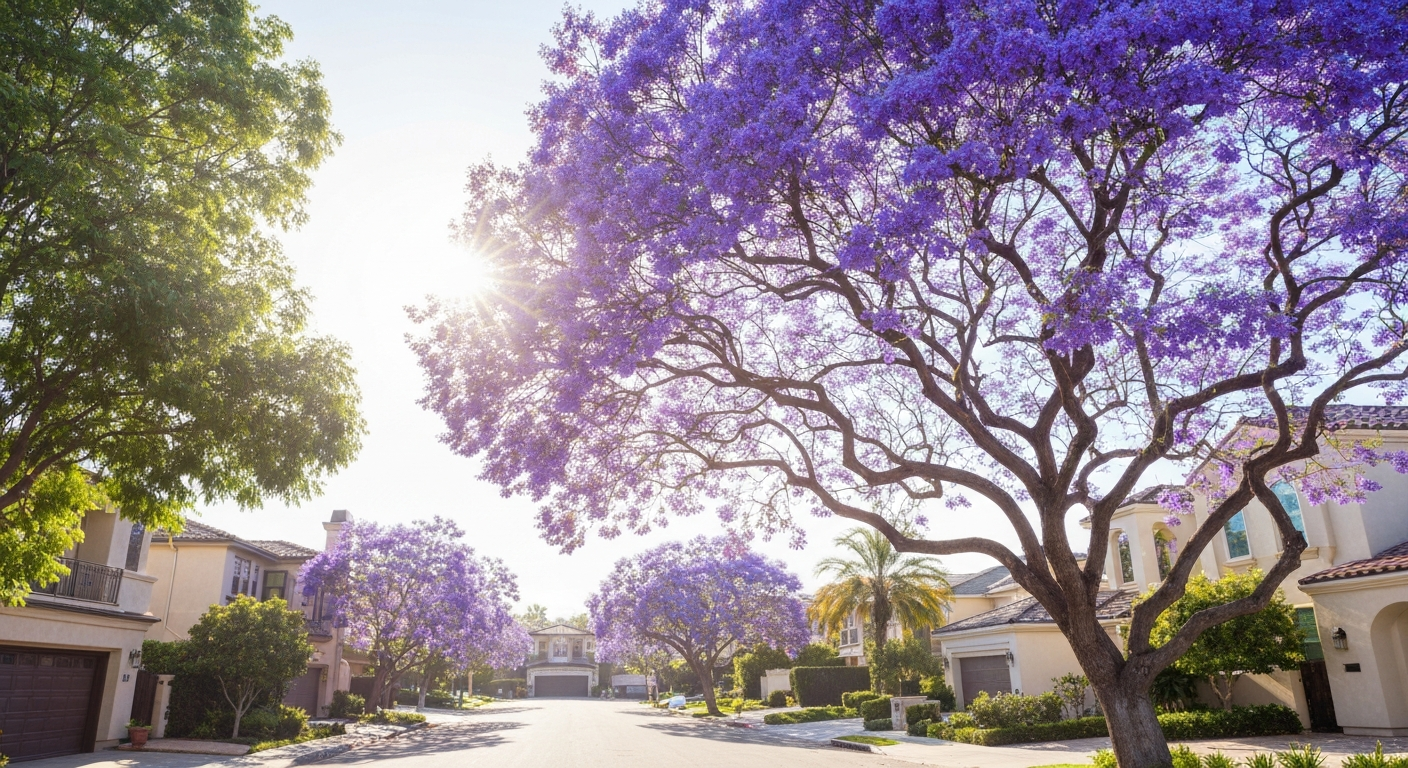
The purple canopy of a blooming Jacaranda is one of Southern California's most iconic seasonal sights. Behind that beauty lies a tree that rewards proper care and suffers noticeably without it.
Understanding the Jacaranda
The Jacaranda (Jacaranda mimosifolia) is native to the dry valleys of South America — Argentina, Bolivia, and southern Brazil. It arrived in Southern California in the early 20th century and became one of the region's most beloved ornamental trees. The bloom period, typically May through June (though often triggered by the first warm days of spring), transforms streets, parks, and estate driveways into lavender-blue canopies unlike anything else in the American landscape.
Jacarandas are moderate to fast growers, reaching 25–40 feet with a vase-shaped canopy. They are semi-deciduous — dropping their finely textured, fern-like leaves in late winter before blooming. The carpet of fallen purple flowers is iconic but also a maintenance consideration for pool areas and detailed landscape designs.
The structural challenge with Jacarandas is their tendency to develop codominant stems and large lateral branches with poor attachment angles. Without structural pruning in youth, they develop architecturally complex and sometimes unstable crowns. Properly trained Jacarandas with a single strong central leader are significantly more stable than those that have been allowed to grow unchecked.
In the right setting with the right management, a mature Jacaranda is one of the finest trees in any Southern California landscape. They deserve more than casual maintenance.
Quick Reference
Common Problems With Jacarandas
Codominant Stems & Structural Failure
Jacarandas naturally want to develop multiple competing leaders. Without early structural pruning, these develop into codominant stems with included bark — one of the highest-risk structural defects in any tree. The weak union between co-leaders can fail catastrophically in wind events or under the weight of a heavy rain-soaked canopy. This is addressable with proper training early in the tree's life. In mature trees, cabling may be needed to reduce the risk of co-leader separation.
Surface Root Damage
Jacaranda surface roots can be aggressive, lifting sidewalks, driveways, and pool coping within 10–20 years of planting. Siting decisions matter enormously. Once surface roots are established, cutting them without assessment can destabilize or stress the tree. Root barriers installed at planting time can direct root growth away from hardscape.
Bloom Failure
Poor or absent blooming is a common complaint. The most frequent causes: over-irrigation (particularly from adjacent turf systems), excessive nitrogen fertilization (promotes leaf growth at the expense of flowers), and insufficient heat and sun. Jacarandas bloom best when mildly stressed — not pampered. Assess irrigation and fertilization programs before assuming disease.
Scale Insects & Aphids
Jacarandas are susceptible to various scale insects and aphids, particularly in stressed or over-watered trees. Infestations produce sticky honeydew, which leads to sooty mold growth on leaves and hardscape below. Early detection and targeted treatment prevents cosmetic and health decline. See our Scale Insects guide.
Frost & Cold Damage
Jacarandas are frost-sensitive. Hard frosts (below 28°F) can kill young trees and damage the crowns of mature specimens. Interior valley sites in Ventura and Los Angeles counties occasionally experience damaging frosts. Frost-damaged branches should be removed in spring after the extent of dieback is confirmed by new growth emergence.
Anthracnose
During wet spring weather, anthracnose fungal infections can cause leaf spotting, premature defoliation, and tip dieback in Jacarandas. Usually not fatal in vigorous trees, but repeated infection weakens the tree over time. Read our Anthracnose guide.
Pruning Jacarandas
Best time to prune: Late summer to early fall, after bloom is complete and before new growth hardens off. Light deadwood removal can be done year-round. Avoid heavy pruning in spring — it will eliminate or reduce the bloom.
Young trees (years 1–10): Annual structural training is the most valuable investment you can make in a young Jacaranda. Select a dominant central leader. Subordinate competing stems. Remove crossing and rubbing branches. This work when the tree is young prevents expensive, high-risk intervention later.
Mature trees: Every 3–4 years for routine crown maintenance. Focus on deadwood removal, structural improvement, and clearance from structures. Do not over-prune — aggressive removal triggers excessive epicormic (water sprout) growth.
Never: Top a Jacaranda. This is one of the most common mistakes made by unskilled contractors. Topping destroys the natural form, stimulates weak water sprout growth, invites decay, and eliminates bloom for years.
Irrigation & Nutrition
Young trees: Regular deep watering every 7–14 days during the first 3 years. Once established, Jacarandas are quite drought-tolerant.
Established trees: Monthly deep watering during dry summers is typically sufficient. Jacarandas near turf irrigation systems often receive too much water — assess whether turf schedules are appropriate for the tree.
Bloom tip: Slightly reduce irrigation in late winter (January–February) to encourage the mild stress that triggers bloom. Resume normal irrigation after flowers appear.
Fertilization: Low to moderate nitrogen applications in early spring. Avoid high-nitrogen fertilizers — they push vigorous leaf growth at the expense of flowers. A slow-release balanced fertilizer applied via deep root injection is ideal.
Soil pH: Jacarandas prefer slightly acidic to neutral soil (pH 6.0–7.0). Alkaline SoCal soils may need amendment to prevent iron deficiency (chlorosis).
Jacaranda FAQs
Why isn't my Jacaranda blooming?
The most common causes are: too much nitrogen fertilizer (promotes leaves over flowers), overwatering (same effect), insufficient heat or sun, or heavy pruning that removed the bloom-bearing wood. Try reducing irrigation in late winter and avoiding high-nitrogen fertilizers. If the tree is in a shaded or cool location, bloom will naturally be reduced.
When do Jacarandas bloom in Southern California?
Typically May through June, though warm spring weather can trigger early blooming in April. Coastal areas with cooler temperatures may bloom slightly later than inland locations. The bloom period lasts 4–8 weeks depending on conditions.
My Jacaranda's roots are lifting my driveway. What should I do?
Do not cut the roots without a professional assessment — cutting significant surface roots on a mature tree can destabilize it. A Certified Arborist can evaluate the root structure and recommend options ranging from root barrier installation to hardscape redesign or, in some cases, removal.
How do I prevent Jacaranda flowers from staining my pool?
There is no way to prevent flower drop — it is a natural and annual event. The practical solutions are: regular skimming during bloom season, running pool filtration more frequently, or relocating a Jacaranda during landscape redesign. Planting Jacarandas downwind from pools reduces the problem.
Is it safe to park under a Jacaranda?
Generally yes, though falling flowers and seed pods are a nuisance on vehicle paint. Larger structural concerns — codominant stems, heavy lateral branches — should be evaluated before parking valuable vehicles beneath mature specimens.
How fast does a Jacaranda grow?
Moderately fast — typically 1.5–2.5 feet per year in good conditions. Trees in warm, inland locations with adequate irrigation establish quickly. Coastal trees in fog zones grow more slowly.
Can I top my Jacaranda to keep it smaller?
Topping is never appropriate for any tree and causes particularly severe damage to Jacarandas. It destroys the natural form, stimulates excessive weak water sprout growth, creates large decay wounds, and eliminates blooming for years. Crown reduction through proper subordination cuts is the correct alternative if size management is needed.
Are Jacaranda roots invasive?
Yes, surface roots can be aggressive in older trees. They seek moisture and can lift sidewalks, patios, and pool coping. This is primarily a site-selection issue — Jacarandas should not be planted within 10–15 feet of hardscape. Root barriers at planting time significantly reduce this problem.
My Jacaranda has yellow leaves. What is wrong?
Yellowing leaves (chlorosis) in Jacarandas is most commonly caused by iron or manganese deficiency in alkaline soils, overwatering, or poor drainage. A soil test will determine the cause and guide appropriate treatment. Deep root fertilization with chelated iron is often the solution.
Related Resources
Get Expert Advice on Your Jacaranda
Whether your tree isn't blooming, has structural concerns, or needs a thorough health evaluation — our ISA Certified Arborists are ready to help.
Schedule a Free Consultation