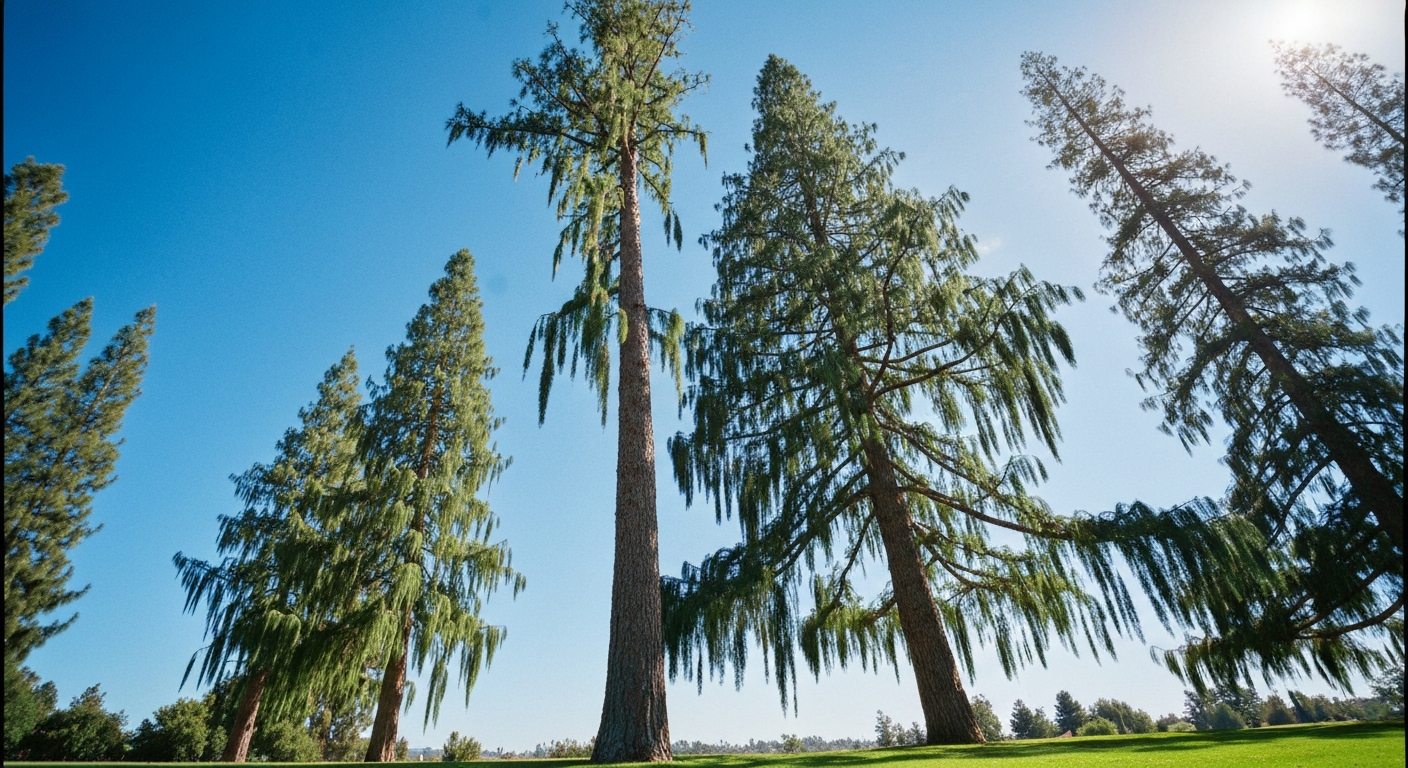
Canary Island Pine
Care Guide
One of the most iconic silhouettes in Southern California landscaping — towering, dramatic, and uniquely vulnerable to bark beetle infestation.
Understanding the Canary Island Pine
The Canary Island Pine (Pinus canariensis) is not native to California — it originates from the Canary Islands off the northwest coast of Africa. Yet it has become one of the most recognizable and widely planted trees in Southern California, prized for its dramatic weeping foliage, columnar form, and ability to thrive in our hot, dry climate.
These trees can reach 60 to 80 feet in height, with a spread of 20 to 35 feet. Their long, graceful needles (12–18 inches) cascade in dense clusters, creating a distinctive silhouette visible across hillsides, medians, and large estate properties throughout Los Angeles, Ventura, and Santa Barbara counties.
Despite their visual dominance, Canary Island Pines are under constant threat from bark beetles — particularly the Western Pine Beetle (Dendroctonus brevicomis) and Ips beetles. A tree stressed by drought, construction damage, or overwatering becomes a target. Once beetles breach the bark, the tree can decline rapidly and irreversibly.
Understanding this species means respecting the balance between its striking presence and its genuine vulnerabilities.
Quick Reference
Why This Tree Thrives — and Struggles — Here
Heat Tolerance
Exceptional. Thrives in full sun and tolerates the intense heat of inland valleys. A natural fit for Thousand Oaks, Calabasas, and Westlake Village.
Drought Tolerance
High once established. Irrigation during the first 3–5 years is critical, but mature trees can survive on seasonal rainfall alone in most SoCal microclimates.
Coastal Performance
Moderate salt tolerance. Performs well in coastal areas but may show tip burn in direct ocean-front exposure. Better suited 1–5 miles inland from the coast.
Wind Tolerance
Generally good, though large specimens may develop structural weaknesses. High-wind events can expose codominant stems to failure — annual inspection is critical.
Where It's Planted
Estate driveways, hillside properties, medians, commercial landscapes, and large residential lots throughout Ventura, LA, and Santa Barbara counties.
Soil Adaptability
Tolerates clay, loam, and sandy soils. Struggles in waterlogged conditions. Well-draining soil and proper irrigation management are essential to prevent root rot.
Common Problems With Canary Island Pines
Bark Beetles — The #1 Threat
Western Pine Beetle and Ips beetles are the most serious threats to Canary Island Pines in Southern California. Beetles are attracted to stressed trees — drought stress, root damage, and overwatering all increase vulnerability. Warning signs: tiny pitch tubes (resin blobs) on the bark, reddish-brown boring dust at the base, yellowing needles from the top down. Once a significant infestation is established, the tree cannot be saved. Prevention is everything. Read our full Bark Beetle guide.
Drought Stress
Extended drought reduces a tree's ability to produce the resin that repels beetles. Trees in drought stress are exponentially more susceptible to bark beetle attack. Deep root watering every 3–4 weeks during dry seasons is the single most important preventive measure. Learn about deep root watering.
Root Zone Damage
Construction activity, grade changes, and heavy equipment within the root zone cause hidden damage that weakens the vascular system. Symptoms may not appear for 2–5 years after the damage. Any construction near Canary Island Pines requires an ISA Certified Arborist to establish a protection plan before work begins.
Overwatering & Root Rot
Counterintuitively, overwatering is as dangerous as drought. Waterlogged soil creates anaerobic conditions that promote Phytophthora root rot and weaken the root system. Turf irrigation schedules are almost never appropriate for Canary Island Pines. Irrigation should be deep, infrequent, and applied beyond the drip line.
Improper Pruning
Topping, lion-tailing (removing interior foliage), and flush cuts are among the most common and damaging practices applied to these trees. Improper cuts create large open wounds, remove the natural defense zones of the tree, and encourage decay. ANSI A300 pruning standards must be followed. Never remove more than 20% of live foliage in a single season.
Nutrient Deficiencies
Yellowing of older needles, sparse canopy, and reduced growth rate often indicate nitrogen, iron, or manganese deficiency — common in alkaline Southern California soils. Deep root fertilization with appropriate slow-release formulations addresses these deficiencies at the root zone where they're most effectively absorbed.
Plant Health Care for Canary Island Pines
Deep Root Fertilization
Annual application of slow-release, high-nitrogen fertilizer injected into the root zone under pressure. Strengthens the tree's natural defenses against beetle attack.
Bark Beetle Monitoring
Regular inspection for pitch tubes, boring dust, and crown discoloration. Early detection is the only effective intervention.
Deep Root Watering
Monthly deep watering during dry seasons maintains the moisture level necessary for resin production — the tree's primary defense against bark beetles.
Annual Arborist Inspection
Structural assessment, pest and disease evaluation, crown health rating. Documents baseline health and detects problems before they become irreversible.
Root Zone Protection
Mulching 3–4 inches deep within the drip line retains moisture, moderates soil temperature, and protects surface roots from equipment damage.
Soil Testing
Determines pH, nutrient levels, and soil structure. Alkaline soils common in SoCal lock up iron and manganese — soil data directs effective fertilization.
Disease Monitoring
Phytophthora root rot and other fungal diseases are monitored during regular site visits. Early diagnosis prevents irreversible crown dieback.
Integrated Pest Management
A proactive, science-based approach that considers the whole ecosystem before applying treatments, minimizing unnecessary chemical use.
Pruning Canary Island Pines
Best time to prune: Late fall through early winter (November–February). Avoid spring and summer when bark beetles are most actively searching for stressed host trees. Fresh pruning wounds in peak beetle season are an invitation for infestation.
Pruning frequency: Every 3–5 years for established trees. Annual pruning is excessive and unnecessarily stresses the tree. Young trees in the first 5 years benefit from structural training to establish a strong single leader.
ANSI A300 considerations: Never remove more than 20% of live crown in a single pruning. Maintain the lower branches as long as the tree's structural and aesthetic goals allow — they contribute significantly to photosynthesis and overall health. Crown raising should be done gradually over multiple seasons.
Common mistakes to avoid: Topping (never appropriate for any reason), lion-tailing (stripping interior foliage), flush cuts at branch unions, and pruning during beetle flight season (April–October).
What good pruning achieves: Removal of dead, diseased, and crossing branches. Improving structure and reducing failure risk at major branch unions. Clearance from structures. Managed crown density to reduce wind-sail effect on large specimens.
Irrigation & Nutrition
Young trees (first 5 years): Water deeply every 7–10 days during the growing season. Apply water slowly at the drip line, not against the trunk. This encourages deep root development and drought resistance.
Established trees: Deep watering every 3–4 weeks during dry seasons. In Southern California's dry summers, this is essential for maintaining the resin production that repels beetles. Do not rely solely on lawn irrigation.
Drought periods: Increase deep watering frequency to every 2–3 weeks. A stressed pine is a beetle-targeted pine. This is non-negotiable maintenance during extended drought.
Fertilization timing: Late winter to early spring (February–March) before new growth begins. A second application in early fall supports the tree through winter. Never fertilize a drought-stressed tree — address water first.
Nutrient signs to watch: Pale yellow-green needles indicate nitrogen deficiency. Interveinal chlorosis (yellow between green veins) on needles suggests iron or manganese deficiency, common in alkaline SoCal soils.
Canary Island Pine FAQs
How do I know if my Canary Island Pine has bark beetles?
Look for small, pitch-coated tubes (resin blobs, roughly pencil-eraser size) on the outer bark, reddish-brown boring dust at the base of the tree or in bark crevices, and yellowing or browning needles starting at the top of the crown. If you see these signs, contact a Certified Arborist immediately.
Can a bark beetle-infested Canary Island Pine be saved?
It depends on the severity and how early it's caught. Light, localized infestations on healthy trees may be managed with systemic treatments and improved care. However, trees with widespread beetle activity and significant crown dieback typically cannot be saved. Early detection is critical — annual monitoring makes a real difference.
Why are my pine's needles turning yellow from the top?
Top-down yellowing in Canary Island Pines is a classic bark beetle symptom. It can also indicate severe drought stress or root problems. Either way, it requires immediate professional evaluation.
How far should I water from the trunk?
Apply water at and beyond the drip line (the outer edge of the canopy), not against the trunk. The feeder roots that absorb water and nutrients are located at the outer extent of the root zone, which typically extends well beyond the canopy.
Should I remove the lower branches from my Canary Island Pine?
Only if there is a specific structural or clearance reason. Lower branches contribute significantly to photosynthesis and overall tree health. Aggressive crown raising weakens large trees over time. Any removal should be gradual and performed by an ISA Certified Arborist.
How fast does a Canary Island Pine grow?
In ideal conditions, 2–3 feet per year when young. Growth slows as the tree matures. In Southern California, trees in well-drained soil with appropriate irrigation and fertilization tend to establish quickly.
Can I plant a Canary Island Pine near my house?
Yes, but consider mature height (60–80 feet) and the distance to structures. These trees should generally be planted at least 20–30 feet from structures. Their root systems are deep rather than aggressively lateral, but proximity to foundations, pools, and underground utilities requires careful planning.
Are Canary Island Pines fire resistant?
No. Like most conifers, they contain significant resinous compounds and dry out during fire weather. They are not recommended for planting within the immediate defensible space zone (0–30 feet from structures). In high-fire-risk zones, fire-resistant species are a better choice.
Why is my pine losing needles in fall?
Some interior needle drop is normal for all pines — older needles are shed as part of the natural growth cycle. If needle loss is heavy, widespread, or accompanied by other symptoms, it warrants professional evaluation.
What is deep root fertilization and does my pine need it?
Deep root fertilization delivers liquid fertilizer under pressure directly into the root zone, bypassing compacted surface soil. It's the most effective way to address nutrient deficiencies and support the immune system of a Canary Island Pine. Annual or biannual applications are recommended for most trees in urban landscapes.
How do I protect my Canary Island Pine during construction nearby?
Establish a protection zone equal to 1 foot of radius per inch of trunk diameter (minimum 10 feet from the trunk in any direction). Install physical fencing before work begins. Prohibit soil storage, equipment staging, and trenching within the protection zone. Have an ISA Certified Arborist involved before, during, and after construction.
When should a Canary Island Pine be removed?
When it presents an unacceptable risk of failure that cannot be mitigated by treatment or pruning, when it has sustained damage or disease beyond the point of recovery, or when it is in a location where failure would cause significant harm or damage. Risk assessment by an ISA Certified Arborist is the appropriate process for making this determination.
Related Resources
Concerned About Your Canary Island Pine?
Bark beetles move fast. If you have any concerns about the health of your Canary Island Pine, don't wait. Schedule a FREE consultation with one of our ISA Certified Arborists.
Schedule a Free Consultation